


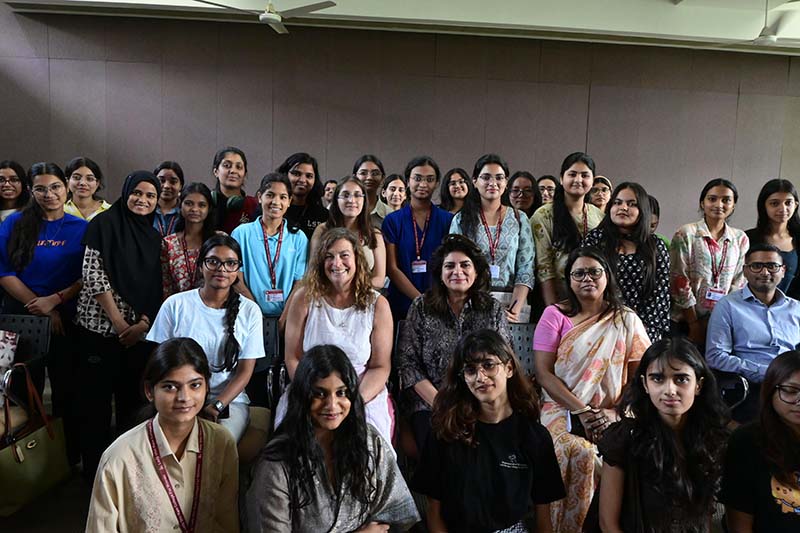
On April 9, 2026, the Office of International Programmes organised a distinguished speaker session on Trust and Marketing in the Online Environment with Ms Julie Brooks, Director of Postgraduate Programmes at the School of Management, University of St. Andrews, UK. The lecture engaged critically with a pressing question in contemporary digital capitalism: how trust is constructed, mediated, and monetised in virtual marketplaces. Ms Brooks foregrounded the argument that the absence of physical proximity in online transactions amplifies classical economic uncertainties, thereby making trust, not price, the decisive variable in consumer behaviour. In doing so, the session resonated with broader debates within behavioural economics and digital sociology, particularly those associated with information asymmetry and platform capitalism. A key conceptual contribution of the lecture was the introduction of the FFF model, which delineates how internal predispositions and external stimuli are filtered through concerns of security and privacy to ultimately shape consumer decision-making. This framework enabled students to analytically map the interplay between technological infrastructure (such as encryption and data protection) and psychological triggers (such as perceived credibility and familiarity).

Ms Brooks highlighted how online reviews, ratings, and user testimonials often supersede traditional advertising and institutional endorsements. This shift reflects a broader transformation in knowledge hierarchies, where horizontal networks of trust increasingly challenge vertical, expert-driven validation systems. The interactive segment of the session was particularly enriching. Students engaged in a dynamic exchange of ideas, raising nuanced questions that bridged theory and praxis. Discussions ranged from the ethical tensions between persuasive marketing and manipulative design (often termed “dark patterns”) to the feasibility of building sustainable trust in an era marked by data breaches and algorithmic opacity. Several students sought guidance on pursuing postgraduate studies abroad, prompting Ms Brooks to share insights on academic pathways, skill requirements, and evolving global education trends. From a pedagogical standpoint, the session significantly enhanced students’ understanding of digital economies by situating marketing practices within larger socio-political and ethical frameworks. It encouraged participants to move beyond a purely functional view of marketing and instead interrogate its normative implications, particularly in relation to consumer autonomy, data privacy, and corporate accountability.