Vasudhaiva Kutumbakam
At Lady Shri Ram College, our Office of International Programmes stands as a key driver of global engagement and intellectual exchange. Since the 1990s, LSR has been committed to fostering meaningful international collaborations that go beyond mere participation in existing academic networks. We aim to reshape the way knowledge is shared and understood, creating an environment where ideas flow freely and reciprocally between the Global South and the Global North. Our goal is to cultivate an academic community that is diverse, inclusive, and forward-thinking, contributing to the global discourse while remaining rooted in our values of critical thinking, intellectual rigor, and global citizenship.
Our Vision: The Office of International Programmes at LSR envisions a world where international academic collaborations are not one-sided exchanges, but dynamic, two-way dialogues. Through a series of innovative partnerships, student mobility opportunities, and cross-disciplinary projects, we ensure that LSR’s contributions to global academia are as influential and transformative as the ideas we receive. We believe that engagement is not simply about participation—it is about shaping the academic future through reciprocal intellectual exchange.
Guiding Frameworks: The B.R.I.D.G.E. and Catamaran Models: At the heart of our approach to internationalization are two guiding frameworks: the B.R.I.D.G.E. Model and the Catamaran Model. These principles underpin every aspect of our international strategy, driving our commitment to fostering cross-cultural and cross-disciplinary exchange.
B.R.I.D.G.E. – Bridging Regions, Ideas, and Disciplines for Global Exchange: The B.R.I.D.G.E. Model encapsulates our commitment to a multi-faceted, reciprocal exchange of knowledge. We seek to bridge regions, ideas, and disciplines, ensuring that our academic engagement spans across diverse geographies and fields of study. This model emphasizes the importance of a dynamic flow of knowledge in both directions, challenging the traditional one-way flow from the Global North to the Global South. Through this, we aim to create meaningful, lasting connections that elevate global discourse and foster mutual growth.
The Catamaran Model – A Metaphor for Global Engagement: The Catamaran Model is a fitting metaphor for LSR’s approach to internationalization. Much like a catamaran’s design enables it to navigate shifting waters with agility, our model emphasizes flexibility, adaptability, and resilience in global academic engagement. It is not a one-way current but a reciprocal exchange, where LSR’s intellectual capital flows both outward and inward, shaping and being shaped by the world’s academic currents. This model ensures that LSR’s contributions are not merely reactive but are resilient, transformative, and grounded in the belief that ideas should not be confined to traditional academic boundaries.
Global Partnerships and Initiatives
Our vision is brought to life through collaborations with esteemed institutions around the world, including:
- La Trobe University (Australia)
- NUS Singapore (Singapore)
- Sciences Po (Paris)
- Fukuoka Women’s University (Japan)
- Macquarie University (Australia)
- Rutgers University (USA)
These partnerships are not just about student mobility; they involve joint research projects, collaborative seminars, guest lectures, and short-term courses that broaden our academic offerings. Our international programs are designed to create a two-way flow of ideas, fostering an environment where knowledge exchange thrives.
A Commitment to Reciprocal Knowledge Exchange
At LSR, we do not merely send our scholars abroad—we ensure that their ideas return enriched, further enhancing the intellectual life of our institution. Our models—B.R.I.D.G.E. and the Catamaran Model—serve as blueprints for a future where LSR plays a pivotal role in reshaping global academic discourse. Through these frameworks, we are building lasting, transformative international partnerships that foster reciprocal knowledge exchange and redefine the boundaries of academia.
The journey of global engagement at LSR is ongoing. By embracing the values of the B.R.I.D.G.E. and Catamaran Models, we continue to extend our intellectual horizons while strengthening our roots in the local context. The Office of International Programmes is dedicated to ensuring that every step we take in this journey contributes to the future of global academia, fostering collaboration, creativity, and critical thought across borders.
Contact us at – internationalprogrammes@lsr.du.ac.in or exchange.lsr@gmail.com
OIP Team
Faculty- Dr Shatarupa Bhattacharya, Ms Bhawana Sharma Jha, Dr Jonathan K. Varghese, and Dr Deepika Papneja.
Student Coordinators
Ms Krittika Sharma, B.A. Journalism (H), 3rd Year- Senior Coordinator
Ms Shruti, B.A. Political Science (H), 3rd Year- Coordinator
Ms Aradhya Agarwal, B.A. Multi-Disciplinary, 3rd Year- Coordinator
Ms Niharika Bantwal Rao, B.A. Economics (H), 2nd Year- Coordinator
Ms Preksha Jain, B.A. Economics (H), 2nd Year- Coordinator
Ms Abhisri Sreeni, B.A. History (H), 2nd Year- Coordinator
Activities in 2025-26
The Office of the International Programmes, LSR, continued to expand its global engagements during 2025-2026 through a series of academic interactions, collaborations, and student opportunities. The Office was honoured to host delegations and engage with representatives from leading universities across the globe, including Hertie School and Rutgers University. These engagements created avenues for discussions on student and faculty mobility, collaborative research, and interdisciplinary learning, reinforcing LSR’s commitment to global academic integration. Interactions with international scholars and institutional representatives contributed to building a dynamic platform for cross-cultural and intellectual exchange.
OIP activities began with nominating outbound students for exchange programs and selecting a new team of coordinators. The coordinators for 2025-26 were Kritika Sharma (Journalism), Ruhi Ahuja (Political Science), Nazmin Fathima M. (Economics), Anwesha Mukherjee (Political Science), and Ritika Pandey (English). The Office celebrated the college’s successful representation at the Asian Undergraduate Symposium, organized by the National University of Singapore, in July 2025. Seven students represented LSR, participated in various events, and were acknowledged for their contributions to the symposium. The group included Kritika Sharma, Mannat Parmar, Niyati Bali, Meenakshi Jha, Anvi Khatri, Noor Sehgal, and Ishpreet Kakkar.
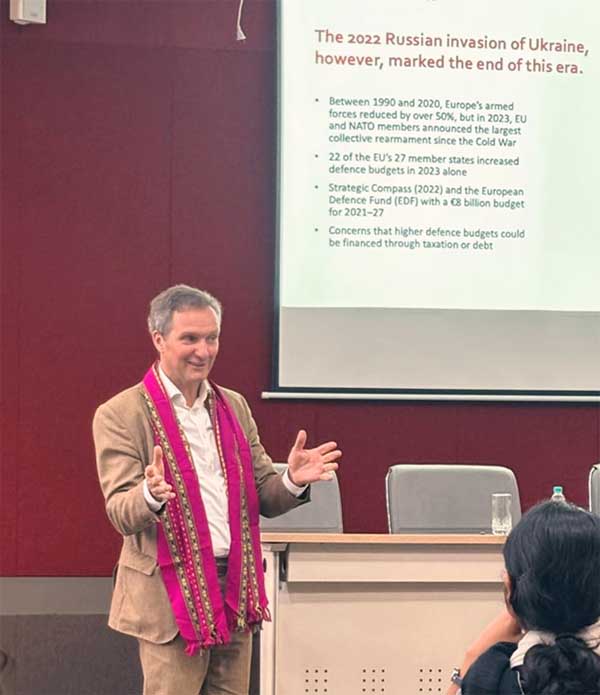
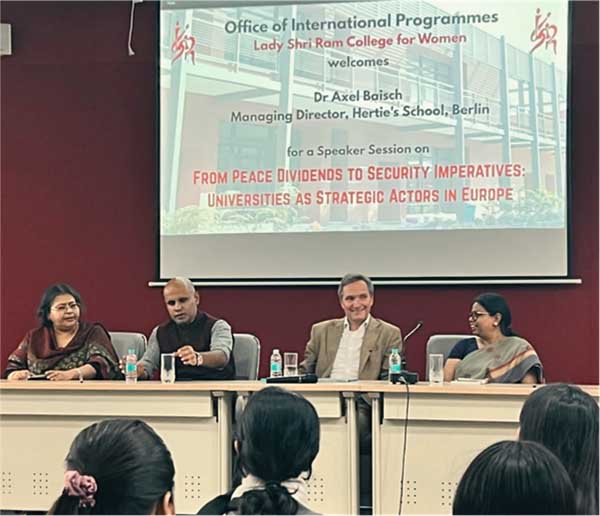
The Office hosted several scholars during the year. Dr. Axel Baisch, Managing Director at Hertie School, Berlin, led a session titled ‘From peace dividends to security imperatives: Universities as strategic actors in Europe’ (29 October 2025). The speaker offered a nuanced analysis of Europe’s transition from the post-Cold War peace dividend era to a contemporary geopolitical landscape marked by renewed security concerns. He traced the decline in defence expenditure across Western Europe following 1990 and contrasted it with the sharp reversal following the Russian invasion of Ukraine, which prompted widespread rearmament and strategic recalibration.
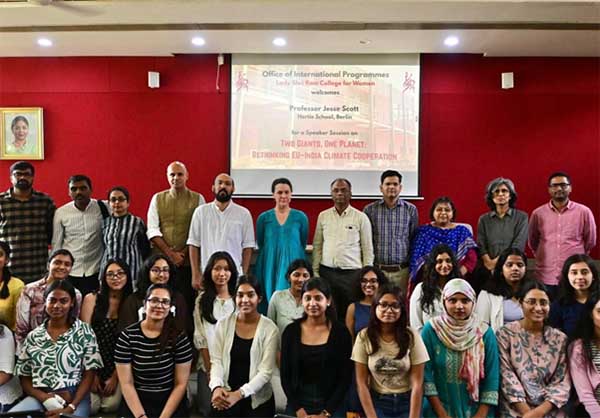
Another session titled ‘Two giants, one planet: Rethinking EU-India climate cooperation’ was conducted with Prof. Jesse Scott, Professor, Hertie School, Berlin, and Senior Fellow at the Observer Research Foundation, Delhi (13 March 2026). Professor Scott brought a comprehensive and interdisciplinary perspective to the discussion, drawing on her extensive experience in climate policy, energy transition, and international governance. Her lecture highlighted the growing importance of cooperation between India and the European Union in addressing global climate challenges, particularly in the context of accelerating environmental crises and evolving geopolitical dynamics.
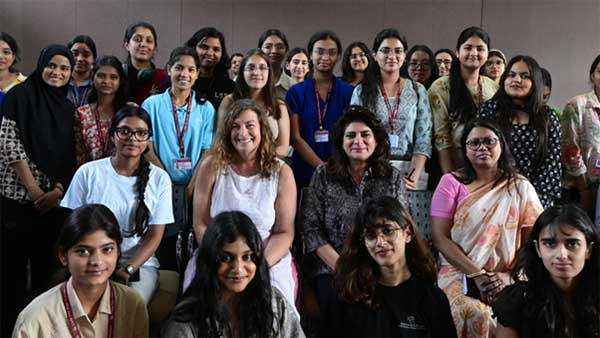
Ms. Julie Brooks, Director of Postgraduate Programmes at the School of Management, University of St Andrews, UK, delivered an address on ‘Trust and marketing in the online environment’ (9 April 2026). The session engaged with a pressing question in contemporary digital capitalism: how trust is constructed, mediated, and monetised in virtual marketplaces. Ms. Brooks foregrounded the argument that the absence of physical proximity in online transactions amplifies classical economic uncertainties, thereby making trust, rather than price, the decisive variable in shaping consumer behaviour. Her insights resonated with broader debates in behavioural economics and digital sociology, particularly those associated with information asymmetry and platform capitalism.
Delegations from various international universities visited LSR. OIP warmly hosted a distinguished delegation from Rutgers University (11 November 2025), marking a significant step toward strengthening global academic collaborations and fostering cross-cultural dialogue. The interaction began with a formal welcome, setting a tone of intellectual exchange and mutual learning. Faculty members and students had insightful discussions on global education, research opportunities, and shared academic interests. The delegates and LSR representatives explored avenues for student exchange programs, collaborative research initiatives, and interdisciplinary learning frameworks.
A significant highlight of the session was the selection of six students from various departments, following a rigorous and competitive process, for participation in the AUS-NUS LSR Undergraduate Symposium to be held at the National University of Singapore in July 2026. The selected students are Maanya Rajgopal, Disha Prajapati, Ruhi Ahuja, Amna Haleem, Bhoomika Kapale, and Vanisha Tyagi. An online orientation session was conducted for the parents of candidates selected for the AUS 2026 programme, with the aim of fostering clarity, confidence, and meaningful engagement. The session provided a comprehensive overview of the Asian Undergraduate Symposium, highlighting its vision, structure, and the diverse opportunities it offers to participating students. Students were selected for a 2-semester exchange with international partners. Ms. Srishti Singh has been nominated to La Trobe University, Australia; Ms. Mannat Parmar was nominated to Fukuoka Women’s University, Japan; and Ms. Anagha Chavan was nominated to Macquarie University, Australia.