


The Internal Quality Assurance Cell (IQAC), Lady Shri Ram College for Women (LSR), successfully launched LSR Summer School 2026, themed “Rooted & Rising: Where Foundation Meets Innovation.” The Summer School offered five online short-term certificate courses that provided interdisciplinary learning opportunities during the summer break by bringing together distinguished scholars and practitioners from India and abroad.
The first course, “Design Thinking for Innovative Entrepreneurship: Incorporating Responsible AI,” was conducted from 22–26 June 2026 with international academic resource support from Rutgers University, USA. Led by Dr. Ratika Gore of Rutgers Business School, the programme introduced participants to the principles of design thinking while integrating the responsible use of artificial intelligence in entrepreneurial innovation. Adopting a human-centred approach, the course encouraged participants to understand users’ needs before developing solutions. AI tools such as ChatGPT and Claude were presented as aids for ideation, research, prototyping, and refining entrepreneurial ideas, while emphasising that human creativity and judgement remain central. Rather than relying solely on lectures, participants worked collaboratively on real-world “wicked problems” through a live group project. Feedback was overwhelmingly positive, with participants praising the expertise of the resource person, the engaging and interactive sessions, the practical Business Model Canvas workshop, and the concluding interaction with an entrepreneur, which connected classroom learning with real-world innovation.
The second course, ‘The India Policy Lab: Foundations of Public Leadership,’ was conducted from 24 June to 4 July 2026 in association with the Delhi School of Public Policy and Governance (Institute of Eminence), University of Delhi. The ten-day online short-term certificate course was designed to provide participants with a comprehensive and interdisciplinary understanding of public policy and public leadership in contemporary India. Across twenty sessions, the programme explored diverse dimensions of policymaking and governance, including public policy frameworks, the relationship between policy and Parliament, the economics of public policy, development and the liberal state, governance and communication, strategic affairs, foreign intelligence and public policy, innovation and entrepreneurship, Viksit Bharat and leadership in public institutions. The programme brought together an accomplished group of policymakers, administrators, economists, academics, entrepreneurs, policy professionals, and public leadership practitioners including Dr. Sanjeev Chopra, Dr. Sanjaya Baru, Sandeep Dholakia, Vasant Dabholkar IAS, Aditya Pittie, Prof. Vidhu Shekhar, Himanshu Joshi, Ram Divedi and Prof. Amit Prakash among other 19 distinguished resource persons. The sessions combined academic perspectives with practical and first-hand insights into policymaking, governance, administration, political processes, economic decision-making, strategic affairs and public leadership. A distinctive feature of the programme was its emphasis on connecting policy theory with real-world practice while exposing participants to diverse career pathways and professional opportunities in the public policy ecosystem. Participant feedback was overwhelmingly positive, with learners expressing strong appreciation for the exceptional calibre and diversity of resource persons, the contemporary relevance of the themes and the depth and accessibility of discussions. The programme successfully created an intellectually stimulating and engaging learning environment and inspiring greater interest in public leadership, governance and policy practice.
The third course, “Mind Craft: Psychology and Indian Knowledge Systems for the 21st Century,” was conducted from 29 June to 9 July 2026. It explored the intersections between psychology and Indian Knowledge Systems (IKS), highlighting their relevance to understanding consciousness, emotions, behaviour, mental health, self-regulation, and holistic well-being. Through ten interactive sessions, the programme encouraged dialogue between traditional Indian wisdom and contemporary psychological thought. The course aimed to help participants appreciate the relevance of IKS in modern life, deepen their understanding of concepts such as Dharma, ethical dilemmas and gender justice, generate research ideas, develop a holistic understanding of texts such as the Ramayana and Mahabharata, and connect these ideas with personal growth. The programme featured eminent scholars including Mr. Pawan Verma, Prof. Shernaz Cama, Dr. Rashmi Singla, Prof. Smita Sahgal, Prof. G. Mishra, Dr. J. Kalavar, Dr. Urmi Biswas, Dr. Parisha Jijina, and Prof. P. Ghai, who offered rich interdisciplinary perspectives on Indian Knowledge Systems. Participant feedback indicated that the course successfully enhanced understanding of IKS, stimulated critical reflection, and inspired further engagement with Indian psychology and related research.
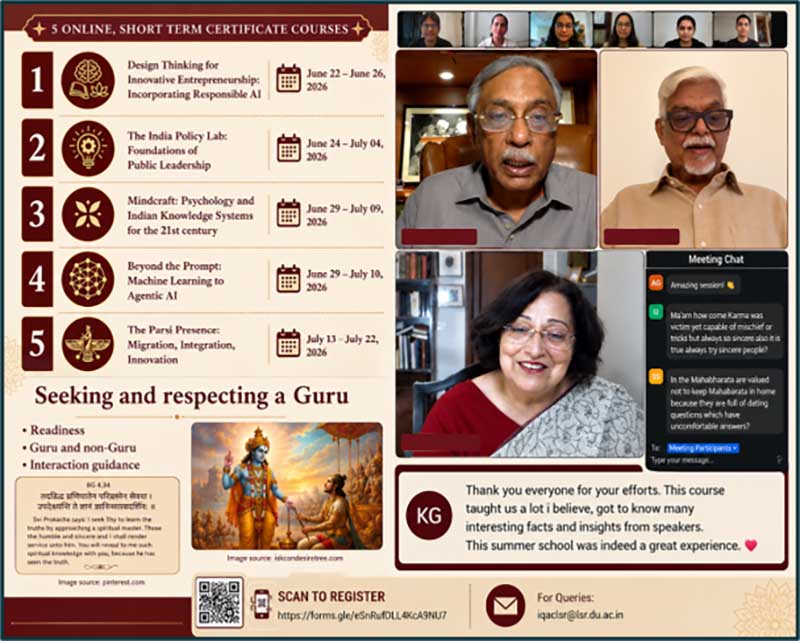
The fourth course, “Beyond the Prompt: Machine Learning to Agentic AI,” was conducted from 29 June to 10 July 2026. Designed to provide participants with a comprehensive understanding of Artificial Intelligence, the programme covered machine learning, prompt engineering, generative AI, conversational AI, and agentic AI through expert lectures, demonstrations, interactive discussions, and hands-on activities. Participants also explored AI applications in healthcare, research, education, economics, and industry, with a strong emphasis on ethical and responsible AI practices. Feedback demonstrated that the programme successfully achieved its objectives, with participants reporting greater confidence in prompt engineering, broader exposure to AI tools, improved understanding of emerging AI technologies, and increased awareness of responsible AI practices. Sessions on AI-driven data visualisation, prompt engineering, conversational AI, and agentic AI were particularly appreciated for their practical demonstrations, real-world applications, and accessibility to learners from diverse academic backgrounds.
The final featured course, “The Parsi Presence: Migration, Integration, Innovation,” was organised from 13–22 July 2026 in collaboration with the Tata Institute of Social Sciences (TISS) and the ParZor Foundation. The ten-day interdisciplinary programme explored the history, religion, migration, culture, and enduring contributions of the Parsi community through lectures, discussions, films, archival resources, and a heritage field visit. Participants examined the evolution of the Parsi community, their contributions to India’s social, cultural, economic, and intellectual development, Zoroastrian beliefs and practices, Parsi artistic traditions, and the important role of women in preserving cultural heritage. The course encouraged critical engagement with themes of migration, identity, diversity, and cultural preservation while connecting historical perspectives with contemporary issues. Participants particularly valued the integration of expert lectures with experiential learning through heritage visits and archival resources, resulting in a deeper appreciation of India’s pluralistic heritage and the continuing significance of the Parsi community.
Across all the programmes, participant feedback was overwhelmingly positive, highlighting the academic rigour, interdisciplinary approach, distinguished resource persons, and practical orientation of the courses. The Summer School successfully fulfilled its objective of creating meaningful learning experiences that combined foundational knowledge with contemporary applications, reaffirming IQAC, LSR’s commitment to innovative, interdisciplinary, and globally relevant academic initiatives.