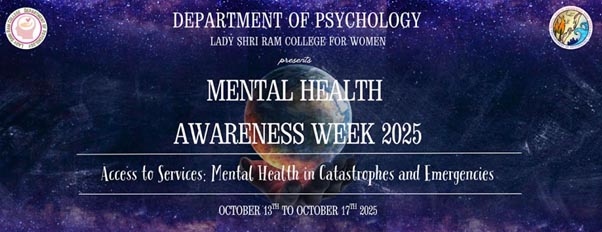
This year’s Mental Health Awareness Week hosted by the Department of Psychology from October 13th to October 17th centred on a crucial theme: “Access to Services: Mental Health in Catastrophes and Emergencies”. We as individuals are subjected to multiple tragic instances occurring in the environment. Events like this remind us that the effects of disasters go way beyond what can be seen from the naked eye. While immediate attention towards medical aid and physical recovery is crucial for survival, addressing the psychological needs of those affected is equally important.
Hence, touching upon this topic felt timely. This year’s focus urged students and attendees to ask themselves an important question – Are we ready to care for our minds as much as we care for bodies in the time of crisis? Throughout the week, several insightful events took place across campus. The Psychological First Aid workshop conducted by alumnae Ms. Vasundhara Gupta and Ms. Vani Bharadwaj provided us with practical tools to assist those experiencing mental distress.
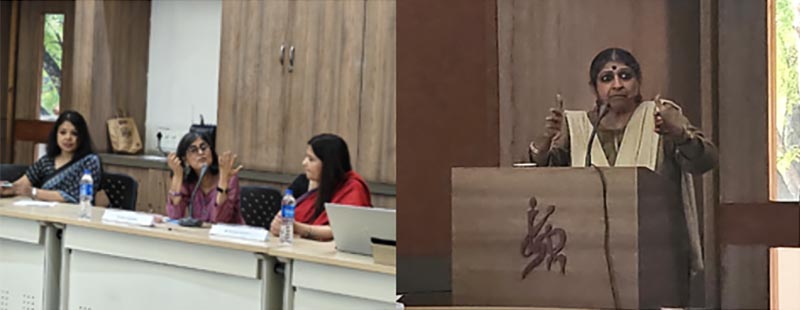
Dr Renu Addlakha, Dr. Garima Srivastava and Prof. Ranganathan
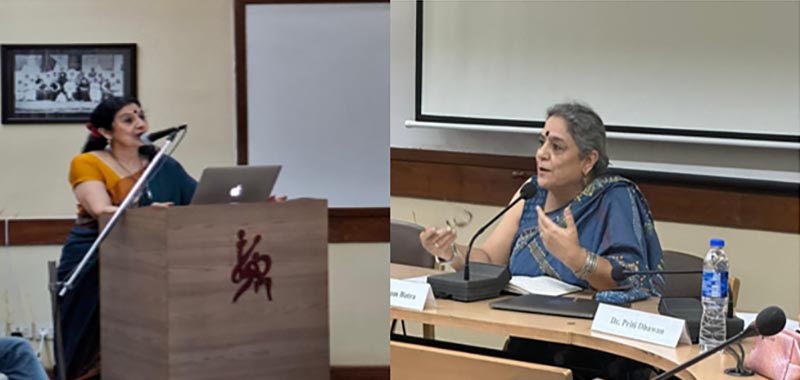
Prof. Priti Dhawan and Prof. Poonam Batra
A panel discussion featuring Dr. Garima Srivastava and Dr. Renu Addlakha delved into the challenges of ensuring equal access to mental health services during emergencies, while another panel led by Prof. Poonam Batra and Prof. Priti Dhawan examined the vulnerabilities of children during crises. A compelling session on “Women’s Mental Health and Emergencies – A Gender Sensitive Lens” by Prof. Namita Ranganathan offered an intersectional perspective on education, empowerment, and recovery. Under the guidance of Dr. Parul Bansal, the reading circle on “Narratives of Loss and Recovery” reflected upon some stories of resilience from tragedies like the Chernobyl Disaster, the Partition, and the COVID-19 pandemic. Dr. Nimisha Kumar through her session on CBT skills in crisis management explained how structured psychological approaches can be helpful during emergencies.
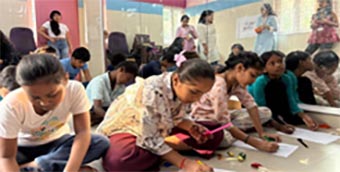
Complementing these academic discussions, the department’s students took the lead in designing and conducting “Mazbooti and Madad,” a workshop for children at an NGO that focused on building resilience and awareness through interactive activities
Mazbooti and Madad
Across campus, wellness booths and engaging interactions invited the wider student community to reflect on self-care, empathy, and mental health awareness in everyday life, making the week both participatory and impactful. As the week came to an end, attendees were reminded that caring for our mental health is not just a personal responsibility, but a collective one. By holding these insightful sessions and activities, the psychology department reinforced the importance of tending to those “hidden scars”, particularly from catastrophes and emergencies, believing that some compassion and emotional support can make all the difference in helping communities heal.