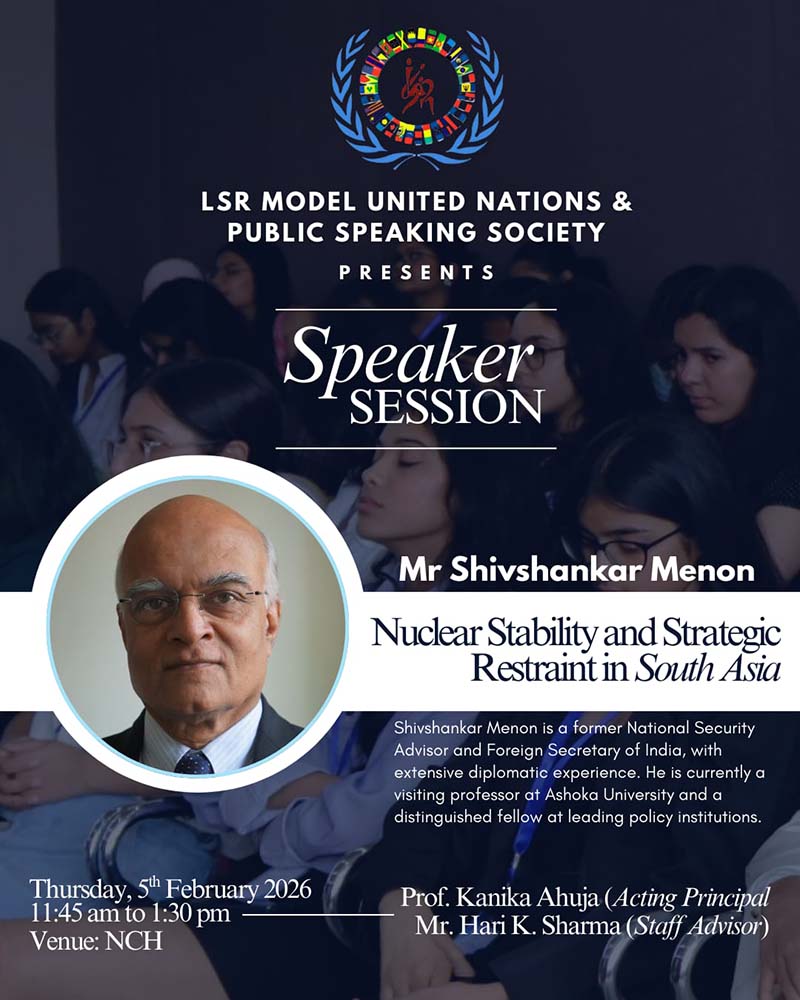
Date: 5th February 2026 (11.45-1.30 PM)
Venue: NCH, LSR
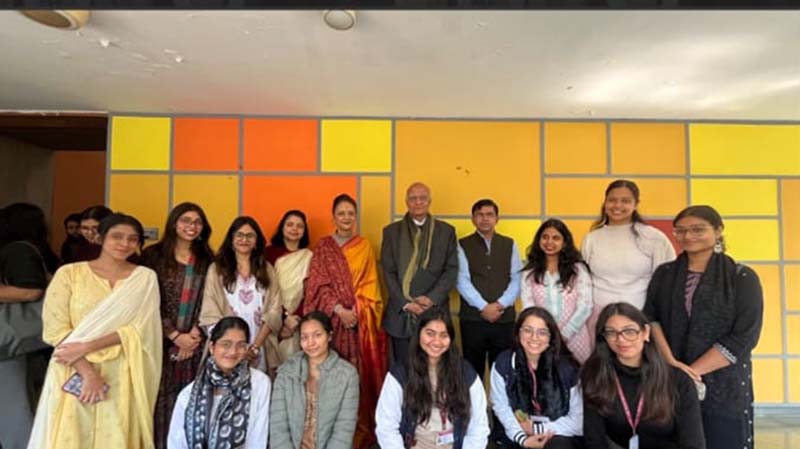
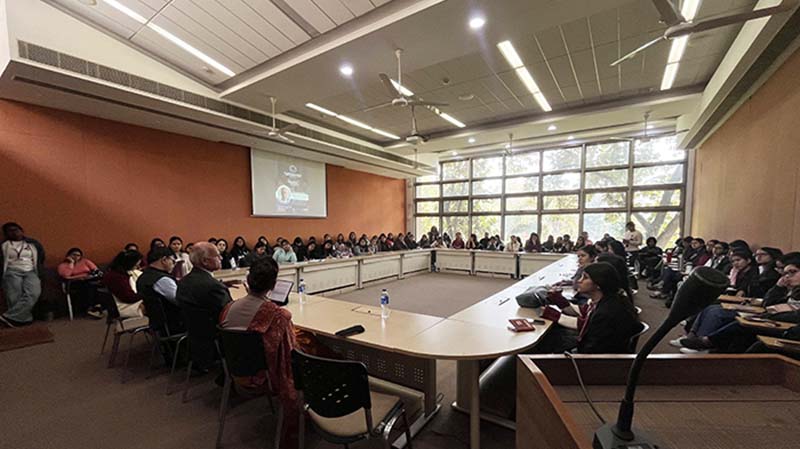
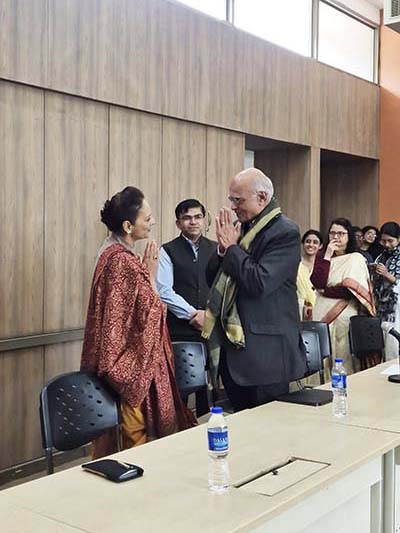
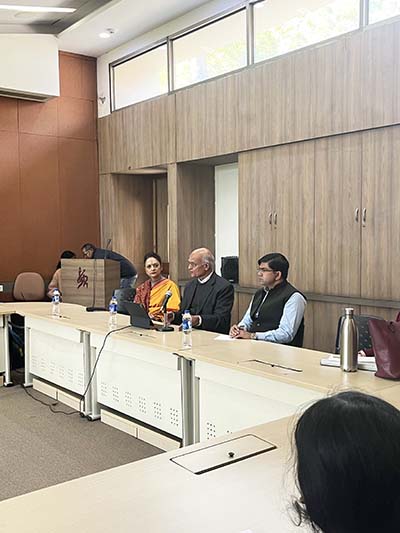
The LSRMUN and Public Speaking Society organised a thought-provoking speaker session with Mr Shivshankar Menon, former National Security Advisor and Foreign Secretary to India on 5th February, 2026 in the New Conference Hall. He eloquently explained the importance of nuclear stability, the use of nuclear bombs and the hidden incentives of nuclear test ban treaties, representing a larger dynamic of geopolitics. Focusing on the session’s theme, Nuclear stability and Strategic Restraint in South Asia, he asserted that nuclear power cannot be properly understood if it is confined to Asia alone, much less to the subcontinent of South Asia. This is due to the profound and far-reaching impact of nuclear power, which affects not only South Asia but also the regional stability of West Asia, Central Asia and the Indo-Pacific. He also discussed the case of Pakistan and explained how nuclear weapons enable asymmetrical warfare and lead to an increased concern for cross-border terrorism.
Mr Menon discussed the Comprehensive Test Ban Treaty (CTBT) and the Non-proliferation Treaty (NPT), and how it leads to innumerable biases and restrictions for developing nations, specifically India. He then emphasised on our ability to modify nuclear weapons as a medium of deterrence and not warfare. Laying emphasis on our abolition of the first use of nuclear weaponry, he attempted to explain the strategic restraints that India witnesses as a developing nation, asserting that India is one of the few countries that decided not to use it as a tactical weapon, which changed our position in the world sphere.
He concluded his speech with a striking reminder that deterrence is inherently subjective and must be examined carefully in light of India’s strategic position and its long-term implications. Mr Menon reflected upon the objective of using nuclear weaponry and how it amplifies one’s position in global platforms. The session ended with an interactive Q&A section wherein Mr Menon discussed the implications of technology on nuclear stability, the role of other countries as mediators and the importance of No First Use.