


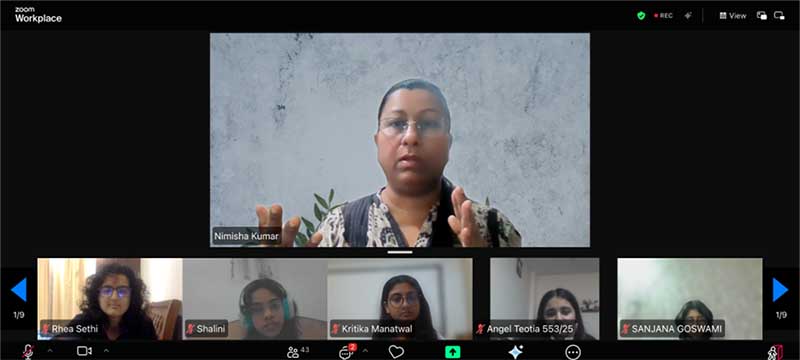
The Department of Psychology conducted an online workshop on 21st February 2026 with Dr. Nimisha Kumar, a CBT practitioner. The session began with a brief introduction of the speaker and moved into an engaging discussion on what Cognitive Behavioural Therapy (CBT) is. Dr. Kumar explained that CBT is rooted in the work of Aaron Beck and Albert Ellis, and described it as a structured, time-limited approach, usually spanning 6–8 sessions. She highlighted its wide applicability across counselling and clinical settings, explaining the difference between what constitutes counselling or therapy depending on the concerns a client brings in.
She explained how our thoughts operate at different levels, from surface-level negative automatic thoughts to deeper intermediate assumptions and core beliefs or schemas. She described emotion as the driving force behind cognition, and opened an interactive conversation with the attendees regarding the emotions that they feel in various situations. The session was highly interactive, and the participants were encouraged to reflect on their own experiences, and to identify the beliefs and schemas that shape their reactions.
The latter half of the session covered practical aspects of CBT, beginning with the importance of goal-setting and the need for counsellors to prioritise listening before moving to intervention. Dr. Kumar discussed several cognitive and behavioural strategies that are used in CBT. She also emphasised that techniques can be applied to oneself, especially in identifying and working through personal cognitive distortions, which is an important first step for aspiring counsellors.