


On the 14th and 15th of October, the Department of Economics, LSR hosted Econvista 2025 2.0, the annual academic conference open to students across the country. The two-day event celebrated the department’s commitment to intellectual curiosity and growth, drawing over 10,000 online registrations and 200 on campus participants across ten inter-collegiate events – making it one of the largest, most vibrant events of LSR.
This year’s theme, “The Economics of Inclusion: Gender Equity and Technology as drivers of India’s development”, highlighted how India’s growth must be driven by inclusive intelligence, where AI fosters equity and gender gaps are bridged.
OPENING CEREMONY
The programme began with the traditional lighting of the lamp accompanied by the rendition of a Vandana. This was followed by a captivating Bharatanatyam performance.
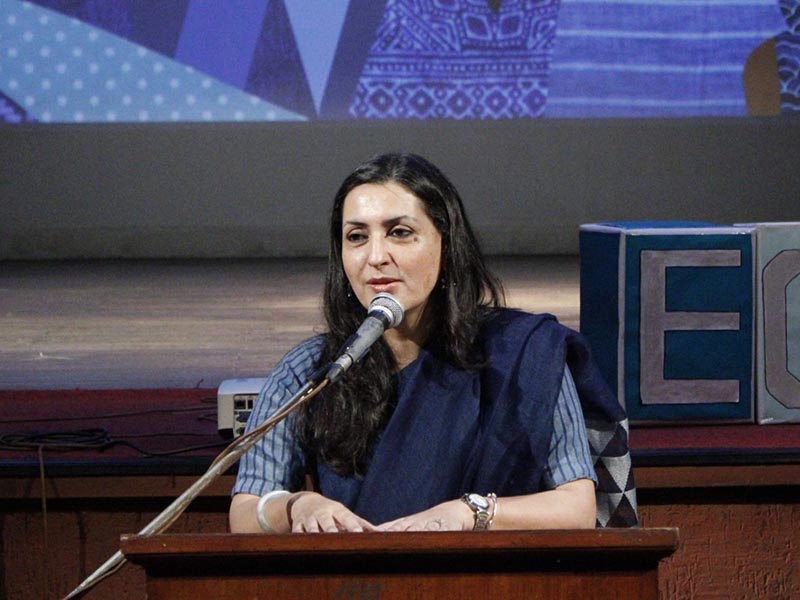
The department had the honour of hosting Ms Mandakini Kaul, Regional Coordinator South Asia, World Bank, as the keynote speaker for Econvista ‘25 2.0. Her address, “Gender Equality is Smart Economics: Investing in Women for Inclusive Growth”, was a blend of statistics, personal experience and strategic vision.
She began with the idea of the ‘Leaky Pipeline,’ explaining how women’s participation in the economy slips through the cracks at different stages. From confronting stereotypes to the real constraints of inflexible jobs and feelings of isolation, her arguments greatly resonated with the young minds in the audience. Through personal anecdotes, Ms Kaul highlighted the positive role that young women can play by actively asserting their own worth in the workplace. Her address left the auditorium buzzing with a collective sense of determination, purpose, and clarity.
PANEL DISCUSSION
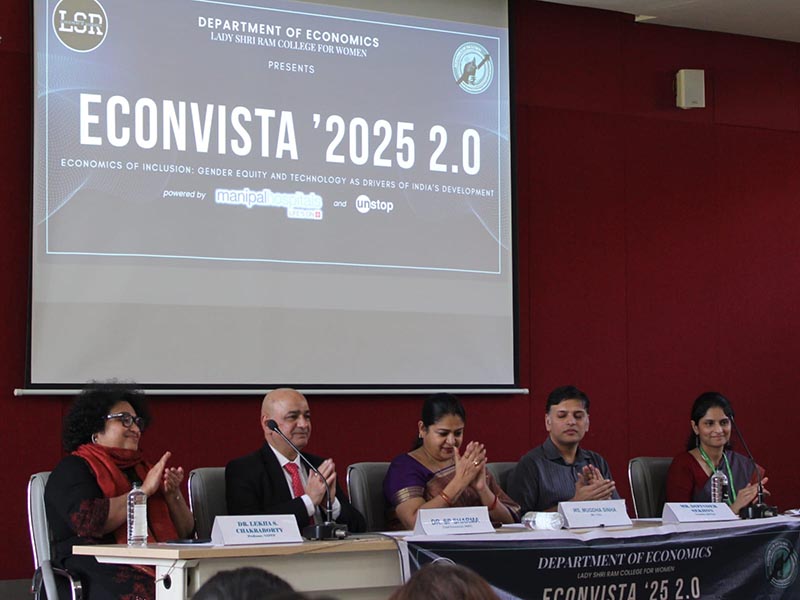
Day 1 also featured a compelling panel discussion on Econvista 2025 2.0’s theme, “The Economics of Inclusion”. The panel comprised eminent speakers who each drew from their expertise, comprehensively exploring the intersections of gender, accessibility, and innovation in India’s economic journey.
Dr Lekha S. Chakraborty, Professor at the National Institute of Public Finance and Policy (NIPFP), focused on the idea that gender in public policy involves innovation. Through financing models like gender budgeting and even gender bonds, innovation can effectively address the cost versus access question for women. Dr S. P. Sharma, Managing Director and Chief Economist, NDIM NEO Research Centre (NNRC), explored the various steps required for the government to achieve Viksit Bharat 2047. He emphasised the role that a robust MSME and startup ecosystem, coupled with ease of doing business, can play in increasing women’s participation in the economy.
To Ms Mugdha Sinha (IAS), LSR alumna and Managing Director, India Tourism Development Corporation (ITDC), bridging the gap means using statistics to identify the missing and invisible women in India’s story. She stressed the need for agnostic policymaking and frameworks that truly support equity. Mr Dipinder Sekhon, founder of iKITES (Innovation in AI and Health), believed that decentralised access to infrastructure is the best way to enable innovation. AI has revolutionised all fields, especially education, to the point where technical skills can be self-taught using material available in one’s own native language. Finally, Ms Supriya Malik, Deputy Director, Ministry of Finance, Government of India, shared her perspective on policy levers that can be used to re-engineer the financial ecosystem. By rethinking the ways
institutions assess the creditworthiness of women, capital becomes accessible to one of the most underrepresented groups in the economy.
Overall, the captivating discourse provided ample food for thought, and the hall resonated with enthusiastic applause as the panel discussion drew to a close.
EVENTS
Econvista 2025 2.0 featured 10 thrilling events, an attractive prize pool across competitions, and over 10,000 registrations from students nationwide.
The competition ‘Eco Prayog’ explored the application of economic principles to real-life challenges, with students tackling the role of Generative AI in public governance. ‘Equinova’ was a premier Business-Marketing competition that required participants to step into the shoes of innovators, exploring the intersection of gender equity, technology, and urban safety. The flagship event ‘Econ-O-Vision 2.0’ challenged teams with the topic “Integrating Artificial Intelligence in the Indian Handicraft Industry”. Day 1 also featured ‘Sawaal Jawaab 4.0’, an exciting quiz show, and the ‘Dr. Saroj Gupta Paper Presentation Competition’, which saw students present insightful research papers on the theme of EconVista.
‘Monopoly Mania 3.0’ was an intellectually engaging event that merged the thrill of high-stakes finance with the timeless appeal of the classic board game. The flagship event ‘Green Gambit’ encouraged participants to reimagine how India navigates the twin challenges of climate change and social inclusion. ‘Policy Dilemma’ was another case-based challenge where teams navigated high-stakes policy trade-offs, optimised fiscal planning and designed scalable solutions on the theme ‘AI integration’. The policy-based competition Case-for-Change involved teams crafting a policy blueprint on ‘Digital Bharat Saarthi’, promoting equitable access to digital infrastructure. ‘EconoVentures’, targeted at the next generation of entrepreneurs, was a premier startup and venture capital-style competition that explored how technology and gender equity can shape India’s development.
CLOSING CEREMONY
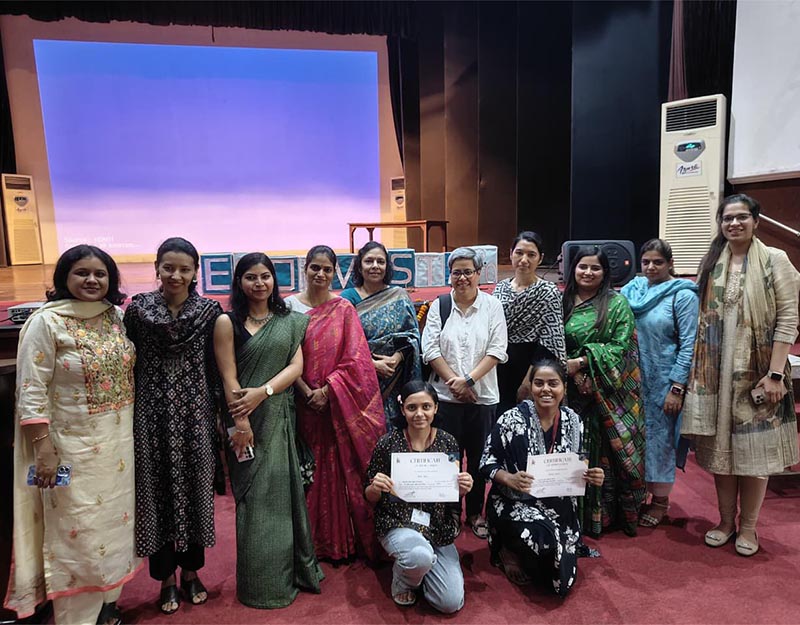
As Econvista ‘25 2.0 came to a close, the atmosphere was bubbling with pride and excitement. A stunning Kathak dance performance set the stage for the celebration to come, and the evening was off to an energetic start. What followed was the much-awaited prize distribution ceremony, awarding the winners of all the competitions held over the past two days. As participants received recognition for their talent, diligence, and perseverance, applause and cheers echoed throughout the auditorium.
The Union of the Economics Department delivered the Vote of Thanks, recognising the relentless efforts of all the organising committee members, faculty members, and sponsors who helped make the event possible. Their speech served as a reminder that the success of such grand events is possible only through collective effort and teamwork.
The ceremony concluded with memories, learnings, and a fulfilling sense of accomplishment, marking the end of yet another successful chapter.